Article written by Elisa
This article may contain compensated links. Please read disclaimer for more info.
Alsace, a historical region now forming part now of the Grand Est region in Eastern France, has both a rich and complex history. Over the past two centuries, the region has alternated between France and Germany, influencing the region’s culture, language, and, of course, its winemaking traditions.
This cross-border influence has led to a unique blend of grape varieties and wine styles found in both Alsace and the Pfalz region, its German counterpart.
The distinct terroir of Alsace, along with its unique winemaking traditions, make it a must-visit region for oenophiles and newcomers alike. The diversity in soils and the drive towards single vineyard wines also makes Alsace a fascinating region to explore, with so much variety of wine characteristics and style on offer.
Are you planning a wine trip to Alsace? Keep on reading to learn when to visit, what to expect, and the best wines to taste!
L’abus d’alcool est dangereux. A consommer avec modération.
Are you planning your Alsace trip last minute?
Below are some of the best Alsace tours, hotels, and more!
- Book your train tickets to Colmar. Book your train tickets to Strasbourg.
Looking to travel around Alsace independently? Click here for the best rental car rates in Alsace.
Top Experiences and Tours in Alsace:
- The 4 Wonders of Alsace Full-day Tour from Colmar
- From Colmar: 3 Villages in France, Germany, and Switzerland!
- Best of Alsace Day Trip from Strasbourg
Top Places to Stay in Alsace:
- Hotel Le Colombier (a traditional building in the Little Venice neighborhood, Colmar)
- Hotel Restaurant Le Maréchal (the cutest place to stay in Colmar at Christmas time!)
- Hotel Cathédrale (with amazing views over the Strasbourg Cathedral)
- Hotel Cour du Corbeau Strasbourg (in a lovely traditional building in Strasbourg)
Don’t leave for Alasce without travel insurance!
SafetyWing Essential plan works well for long and short trips (from 5 days up). Can also cover electronics theft through their add-on.
Table of Contents:
About the Alsace Vineyards
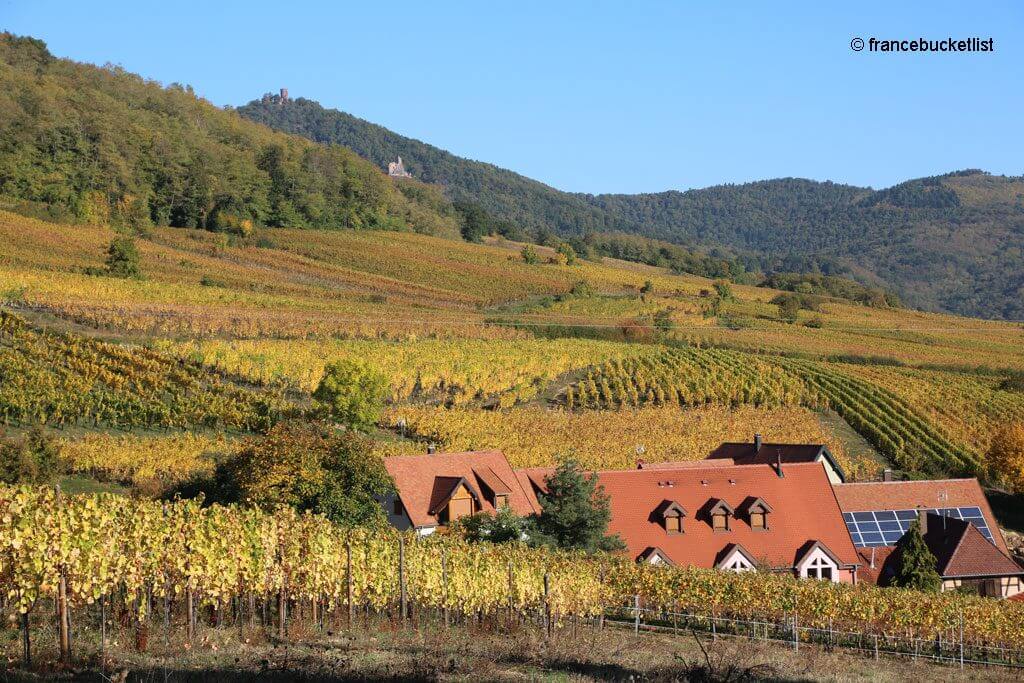
The Alsace wine region is the easternmost wine region in France, located in the departments of Haut-Rhin and Bas-Rhin. Known for its diversity in soil type (a whopping 13 in total!), Alsatian wines exhibit unique characteristics depending on the soil they’re grown in. This makes exploring various wineries across the region such a rewarding process.
Alsatian vineyards are dominated by white grape varieties, with four noble ones taking center stage. These are Riesling, Gewürztraminer, Pinot Gris, and Muscat, which are all celebrated for their versatility and aromatic intensity.
Wine styles are often dry, aromatic, and rich in flavor, which are all characteristics that have become synonymous with Alsatian wines. Most of the region’s wines are varietal, which really allows the region’s individual grape varieties to showcase themselves. In addition to the four noble white varieties mentioned above, Sylvaner, Pinot Blanc, Auxerrois, Savagnin Rose, and Chasselas are also used for the production of white wines.
Although white wines are the focus, Alsace also produces small quantities of red wines made predominantly from the Pinot Noir grape.
Wine Appellations and Wine Styles in Alsace
It’s also important to talk about the AOC’s (Appellation d’Origine Contrôlée), of which Alsace has 53.
There is the main Alsace AOC and a further 51 Grand Crus linked to specific vineyard parcels within the region. These Grand Crus are mainly located in the Haut-Rhin department, a short distance from Colmar.
If you love bubbles, you’ll find excellent sparkling wines under the appellation Crémant d’Alsace. Blanc or rosé the Crémant d’Alsace is made using the Traditional Method (with a second fermentation in the bottle) and the grapes Auxerrois, Chardonnay, Pinot Blanc, Pinot Gris, Pinot Noir, and Riesling.
If you like sweet wines, don’t miss the Vendanges Tardives (VT), late-harvest wines with rich, concentrated flavours, or the Sélection de Grains Nobles (SGN), noble rot-affected sweet wines of exceptional quality. These are not separate appellations but complementary terms to AOC Alsace and AOC Alsace Grand Cru.
The Alsace Wine Region does not have IGPs (Indication Géographique Protegée).
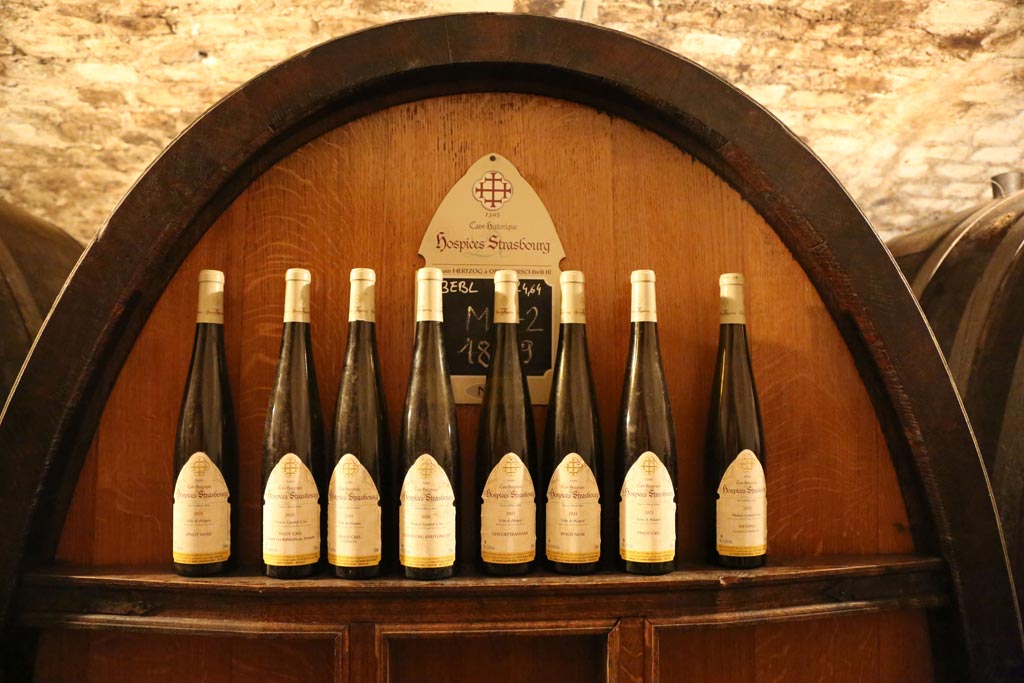
Another distinctive feature of the Alsace wine region is its bottles. Since 1972, all Alsace wines must be bottled within the region, using the traditional flûte du Rhin.
The Alsatian Vineyard is also one of the most important biodynamic vineyards in Europe, playing a key role in France’s commitment to sustainable and organic practices.
Main Wine Producers in Alsace
This is a (non-exhaustive) list of the main wine producers in Alsace. It is also worth exploring the smaller producers (vignerons indépendants), which also made excellent wines.
Producers:
- Léon Beyer
- Agathe Bursin
- Domaine Marcel Deiss
- Famille Hugel
- Domaine Josmeyer
- Maison Gustave Lorentz
- Domaine Albert Mann
- Domaine Muré
- Domaine André Ostertag
- Domaine Pfister
- Domaines Schlumberger
- Domaine Trimbach
- Domaine Zind-Humbrecht
Alsace Towns and Villages
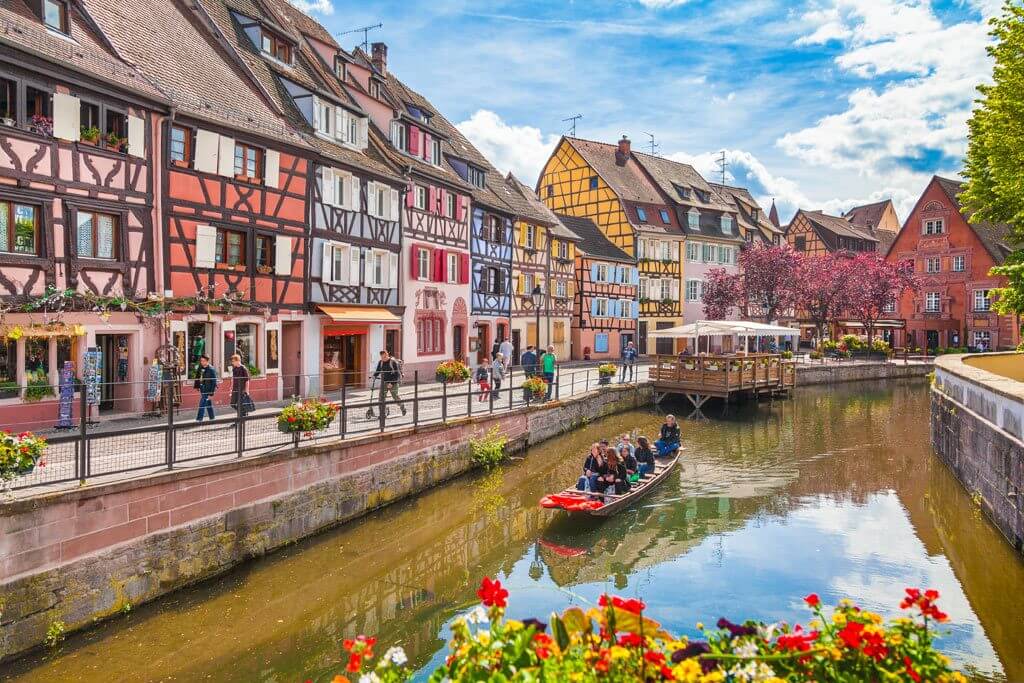
Strasbourg, the capital of Alsace, and Colmar are the main hubs of the region and both are very easy to reach from Paris and neighboring countries.
Strasbourg (Bas-Rhin) is located at the northern end of the Alsace Wine Route and makes a great starting point if you plan to drive the route from north to south. Don’t miss La Petite France, its most picturesque neighborhood, the city’s imposing Cathedral, and the Strasbourg Christmas Market during the holiday season.
Colmar (Haut-Rhin) is Alsace’s wine capital and is better situated for wine-focused day trips. You’ll fall in love with its beautiful architecture and charming canals.
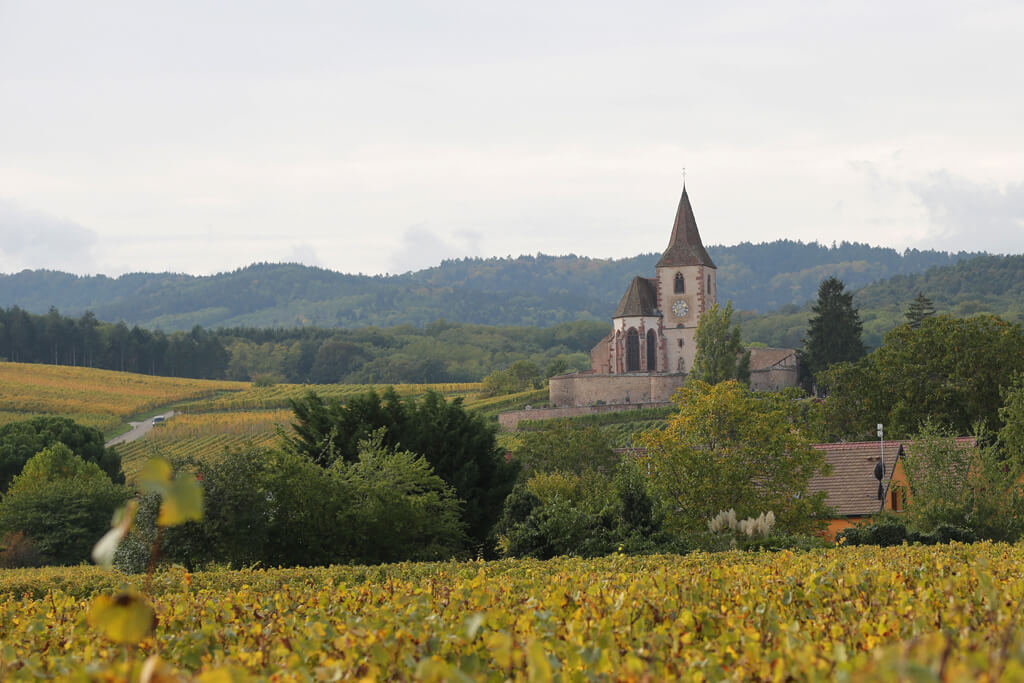
Riquewihr, Eguisheim, and Ribeauvillé are three fairy-tale towns seemingly frozen in time since the 16th century. Their picturesque architecture, well-preserved fortifications, and historic wine cellars make them must-visit destinations for wine lovers and sightseers alike.
Alsace Drives and Walks
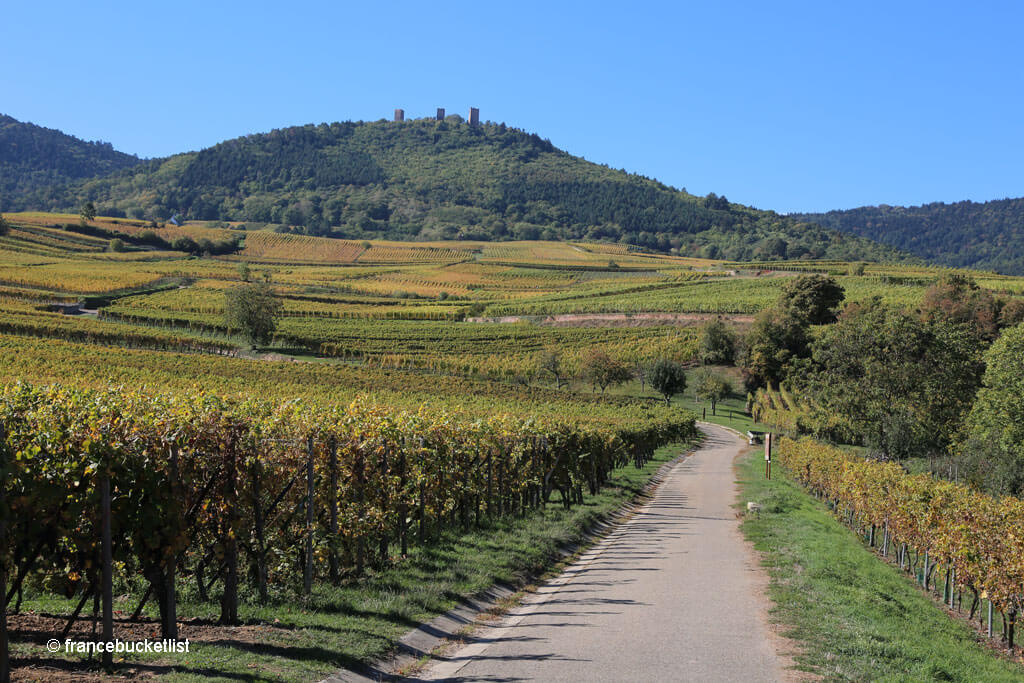
Take the Alsace Wine Route
The Alsace Wine Route (Route des Vins d’Alsace) is an unforgettable 170 km-wine trail, running from Marlenheim to Thann in Eastern France. Think of stunning landscapes, charming countryside villages, and, of course, excellent wines.
If you have the time, then this 5-day Alsace Wine Route road trip cannot be missed, with plenty of opportunities for sightseeing, outdoor activities, and winery visits.
Hiking Trails
Most of the wine towns in Alsace are surrounded by vineyards. These winemakers’ trails are well marked and perfect for a scenic walk through the vines, punctuated with informative panels about wine and the work of the vineyard. Whether you’re a casual stroller or an experienced hiker, you’ll find a trail suited to your time, interests, and fitness level.
With more time, the Vosges offers diverse landscapes, where every path reveals a new perspective on its calm, unspoiled beauty. Winding forest trails and gentle peaks make hiking in the Vosges a rewarding escape into nature.
City Walks
Explore the best of Strasbourg and learn about its fascinating history with this Strasbourg walking tour in English.
Discover Colmar’s Old Town, including the picturesque Little Venice neighborhood, with this guided walking tour in English.
Alsace Wine Tastings and Tours
It’s important to note that if you’re planning on visiting the various wineries in Alsace, you will need to rent a car. Unfortunately, this is very little public transport available at best (often there is none), and the wineries are located quite far from the major cities.
If you don’t have your own car, it’s a great option to rent one from either Colmar or Strasbourg. You have some great options like DiscoverCars to take care of your rental needs, offering a range of choices to suit your needs and budget.
You should also always book your winery visit ahead of time by at least a few days to avoid the disappointment of being turned away. This will need to be done even further in advance during holidays and other busy periods.
Here are some wineries offering well-rated wine tours with tastings in English and German:
- Domaine Martin Jund (Colmar)
- Domaine Hust (Turkheim)
- Dopff au Moulin (Riquewihr)
- Bott Frères (Ribeauvillé)
- Domaine Muré (Rouffach)
- Domaine Kirrenbourg (Kaysersberg)
- Domaine Emile Beyer (Eguisheim)
- Domaine Mann (Eguisheim)
- Maison Cattin (Voegtlinshoffen)
A typical winery visit will entail a tour around the winery and its facilities followed by a guided tasting of selected wines, which usually lasts up to two hours depending on your pace. I’d recommend a maximum of 4 winery visits in a day to avoid an overstimulation of information (and wine).
Lastly, either spit, have a designated driver, or book a tour – wine and cars don’t mix well. Safety first!
Alsace Wine Tours
Guided wine tours in Alsace offer several benefits over independent visits, including no driving concerns, optimized itineraries, and expert local guides often holding a French wine diploma. These tours feature small, fun groups, making the experience more enjoyable, especially after a glass or two.
Most tours start in Colmar, the closest town to the wine villages. If you’re based in Colmar, the Alsace Wine Museum is the perfect introduction to your wine trip. Fun and interactive, the visit ends with a wine tasting.
Some tours also depart from Strasbourg, offering added flexibility and convenience for visitors looking to explore the region’s renowned wines. If you’re staying in Strasbourg, don’t miss the Hospices de Strasbourg – a place steeped in time and home to the world’s oldest wine, still maturing in a barrel since the 15th century.
Best Alsace Wine Tours from Colmar
- Alsace Half-Day Wine Tour (4 hours)
- Alsace Full Day Wine Tour (8 hours)
- Private Alsace Wine Tour (8 hours, also departures from Basel and Mulhouse)
Best Alsace Wine Tours from Strasbourg
- Half-Day Excursion to Alsace (4 hours)
- Alsace Full Day Wine Tour (8 hours)
Alsace Wine Travel Itineraries
3-Day Wine Lover’s Tour
- Day 1: Explore Colmar. Visit the Museum of Alsatian Wines, the Domaine Martin Jund, and the beautiful Musée Unterlinden.
- Day 2: Drive to Riquewihr. Visit Dopff au Moulin to taste its wines and explore the town’s surrounding vineyards.
- Day 3: Take a day trip to Strasbourg. Visit the Cathedral, the Grand’ Ile, and the Cave des Hospices de Strasbourg. End your day at Le Comptoir des Vins Alsaciens for some (wine) souvenirs.
5-Alsace Wine Route
- This Alsace Wine Route road trip itinerary explores the best of the Alsace Wine Route.
7-Day Best of Alsace
- This Alsace Road Trip covers part of the Alsace Wine Region, but it also visits other interesting sites near this route.
Best Time to Visit the Alsace Wine Region
- Spring (April – May): mild weather, fewer crowds, blooming vineyards. The Alsace iconic storks are back in town
- Summer (June – August): it’s the high season in Alsace. Expect warm temperatures, and outdoor wine festivals. The Colmar Wine Fair in August showcases over 300 Alsatian wines, paired with great food, and live music.
- Fall (September – November): harvest time, harvest festivals, beautiful foliage. Some vineyard trails may be closed to the public during the harvest
- Winter (December – March): visit the iconic Alsace Christmas Markets and enjoy cozy wine tastings.
Getting There and Around

Air: Fly into Strasbourg Airport (SXB) or Bâle-Mulhouse-Fribourg (BSL) (MLH) (EAP). You can also fly to Paris Charles de Gaulle (CDG) and take a TGV (fast train) from Charles de Gaulle’s Terminal 2.
Train: Strasbourg and Colmar are the main hubs of the region and both are very easy to reach from Paris and neighboring countries by train.
Car: Alsace’s main cities are well connected by train. But if you’re planning on visiting the various wineries in Alsace, you will need to rent a car. If you don’t have your own car, it’s a great option to rent one from either Colmar or Strasbourg. You have some great options like DiscoverCars to take care of your rental needs, offering a range of choices to suit your needs and budget.
Wine Shops & Bars
Looking for a unique souvenir for your wine cellar or one last drink to end the day? Here’s a curated list of some of the best wine shops, offering an extensive selection of local wines, and atmospheric bars in Alsace.
- La Cave de Turckheim – Wine Cellar (16 Rue des Tuileries, Turckheim)
- Cave des Hospices de Strasbourg – Wine Cellar and Shop (1 Place de l’Hopital, Strasbourg)
- L’Alsace à Boire – Wine Bar and Shop (14 Rue du 22 Novembre, Strasbourg)
- Le Comptoir des Vins Alsaciens – Wine Shop (10 Place Guttenberg, Strasbourg)
- Domaine Viticole de la Ville de Colmar – Wine Shop (27 Grand Rue, Colmar)
- La Folie – Wine Bar (14 Av. Jean de Lattre de Tassigny, Colmar)